AI Readiness for Australian SMEs: What the Research Shows
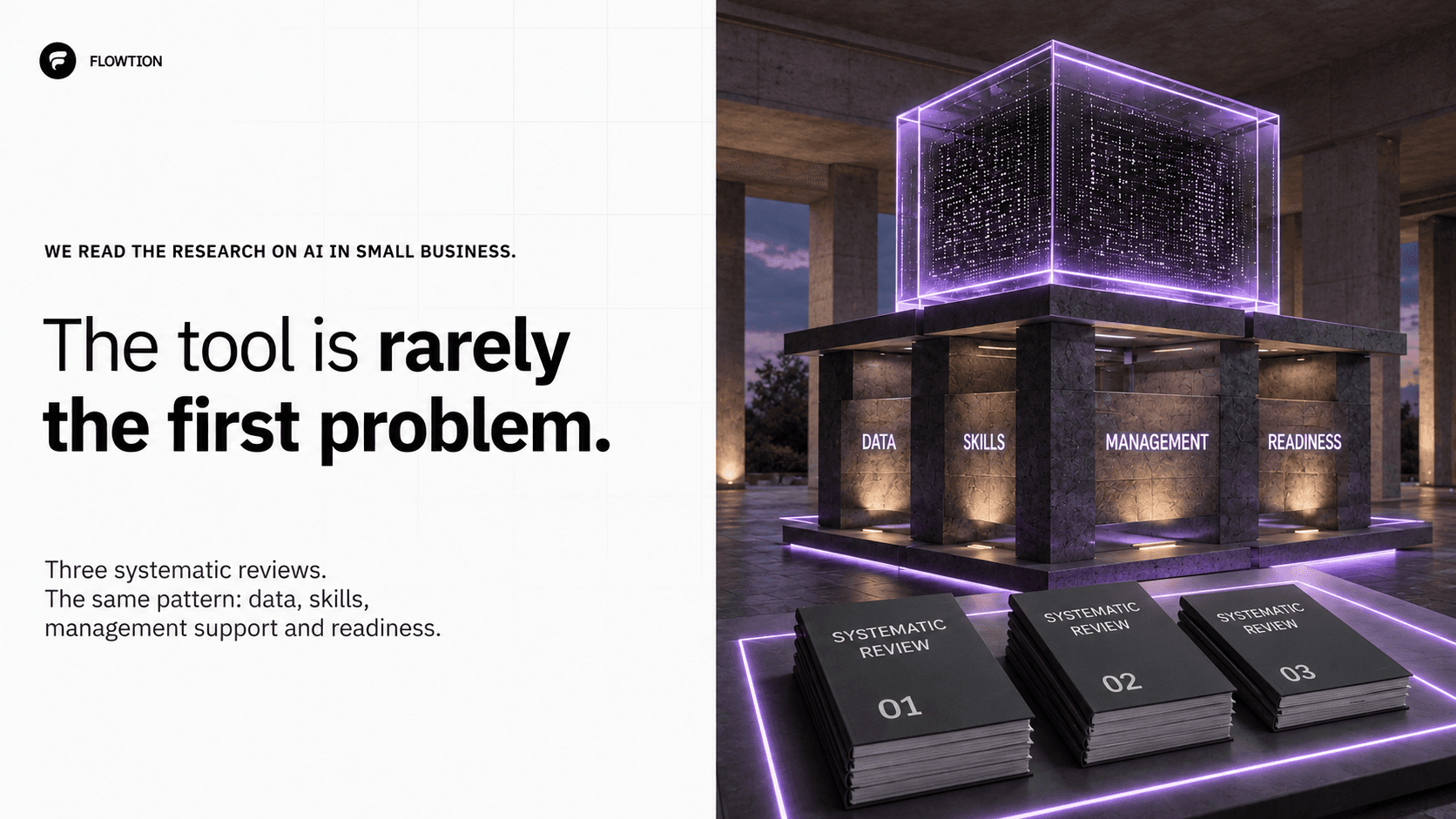
We reviewed three systematic reviews covering roughly 200 peer-reviewed studies on AI in small business. The finding that keeps repeating: outcomes are predicted by the condition of the business, not the sophistication of the tool. Four questions to ask any AI consultancy — including us.
5 Aug 2026 · 5 Mins read
By Flowtion, 5 August 2026. Every statistic checked against the original source.
There is a question worth asking anyone selling AI to your business.
What is your evidence?
We asked it of our own industry. Then we went to the peer-reviewed research on AI adoption in small and mid-sized businesses.
The literature does not name the best model, platform or consultancy. It keeps returning to something less exciting and more useful.
The condition of the business matters before the sophistication of the tool does.
Research note: Flowtion reviewed three systematic reviews. Two covered 149 paper inclusions between them; the third examined peer-reviewed Scopus literature published from 2020 to 2024. We did not independently review every underlying paper, and some papers may appear in more than one review. One of the reviews focused specifically on industrial and manufacturing SMEs, so its findings should not be treated as universal.
The first problem is usually inside the business
Oldemeyer, Jede and Teuteberg screened 1,395 records and selected 71 peer-reviewed studies on AI in industrial and manufacturing SMEs.[1]
They identified 27 implementation challenges. The most common were lack of knowledge, cited in 35 studies; cost, 24; low digital maturity or weak IT infrastructure, 17; limited data availability, 16; management support, 14; difficulty assessing return on investment, 13; and data quality, 12.
Tool choice did not lead the list.
A separate review by Ayinaddis analysed 78 peer-reviewed papers covering SMEs and large firms. It organised the evidence across ten dimensions, including technology readiness, data, skills, financial readiness, management support and regulatory compliance.[2]
Yesuf and colleagues reached a similar conclusion in another systematic review: AI adoption depends on a cluster of organisational readiness, infrastructure, human capability and financial capacity.[3]
Different researchers. Different scopes. The same stubborn pattern.
The market talks about what AI can do. The research keeps asking whether the business can support it.
This does not mean every solution must be custom
Generative AI has lowered the cost and technical barrier to entry. In a 2026 survey of SMEs operating on digital platforms, the OECD found that off-the-shelf AI was most commonly used for marketing.[4] The sample was more digitally mature than the wider business population, so the result should not be read as a national adoption rate.
That matters. A useful tool does not become useless because it came from a shelf.
But easy access has not removed the readiness gap. In the same survey, 76 per cent of AI-using firms were classified as "AI novices", relying on simple tools for isolated tasks rather than integrating AI across their operations.[4] The OECD identifies digital maturity, the complexity of AI use and the breadth of its application as three dimensions shaping adoption. It also names connectivity, access to quality data and computing resources, skills and finance as critical enablers.[5]
The evidence does not say every business needs a grand transformation programme. It says the starting point cannot be assumed.
That is the buying signal.
The Australian data tells the same story
The Australian Bureau of Statistics found that 19 per cent of innovation-active small businesses used AI in 2024–25. Among small businesses with no innovation activity, the figure was 4 per cent.[6]
That is an association, not proof that one caused the other. But AI use is clearly clustering in businesses already able to introduce new processes, services or ways of working.
The National AI Centre found that 44 per cent of Australian SMEs reported some AI adoption in February 2026. Among businesses not intending to adopt AI in the following 12 months, trust was the largest barrier. Around 65 per cent cited distrust in AI decision-making or a preference to keep people in control.[7]
Access is getting easier. Readiness and trust are not moving at the same speed.
Four questions to ask any AI consultancy
If you are choosing an AI consultancy, or being pitched by one, ask these. Ask us too.
1. What happens before you recommend a tool or build anything? A serious answer should begin with the work: the process, the people, the systems and the problem worth solving.
2. Which readiness factors will you assess? Listen for data quality, digital maturity, internal knowledge, management alignment, risk and ownership.
3. Where would AI not help us? If the answer is nowhere, they are selling possibility rather than judgement.
4. What is the before-number? If nobody records the current time, cost, error rate or delay, the result cannot be measured later.
Steal the questions. Send them to whoever is pitching you this week.
Flowtion's Audit exists for this reason. We map the workflow, test readiness and capture the before-numbers before anything gets built. The work is yours whether the next step involves us or not.
Not because every business needs a long diagnosis.
Because every business deserves a recommendation based on the one it actually is.
References
- Oldemeyer, L., Jede, A., & Teuteberg, F. (2024). "Investigation of artificial intelligence in SMEs: a systematic review of the state of the art and the main implementation challenges." Management Review Quarterly, 75, 1185–1227. https://doi.org/10.1007/s11301-024-00405-4
- Ayinaddis, S. G. (2025). "Artificial intelligence adoption dynamics and knowledge in SMEs and large firms: A systematic review and bibliometric analysis." Journal of Innovation & Knowledge, 10, 100682. https://doi.org/10.1016/j.jik.2025.100682
- Yesuf, Y. M., Fields, Z., Jain, A., & Kassa, E. T. (2025). "Artificial Intelligence Adoption as a Driver of Innovation and Competitiveness in SMEs: A Bibliometric and Systematic Review." F1000Research, 14, 1187. https://doi.org/10.12688/f1000research.171494.1
- OECD (2026). Empowering SMEs in the age of AI: The 2026 OECD D4SME Survey. OECD SME and Entrepreneurship Papers, No. 78. https://doi.org/10.1787/bf5a9816-en
- OECD (2025). AI adoption by small and medium-sized enterprises. https://doi.org/10.1787/426399c1-en
- Australian Bureau of Statistics (2026). Characteristics of Australian Business, 2024–25. https://www.abs.gov.au/statistics/industry/technology-and-innovation/characteristics-australian-business/2024-25
- National AI Centre (2026). "AI adoption insights: December 2025 to February 2026." https://www.ai.gov.au/news-and-insights/blog/ai-adoption-insights-december-2025-february-2026
Got a workflow that should run itself?
Tell us where the friction is. We will show you what is worth automating — and what is not.