Australia now has an Office of AI. Most businesses still don't have anyone responsible for AI.
Australia now has an Office of AI. Most businesses still can't answer a simpler question: who is responsible for AI in the business? Not who uses it. Who owns it.
15 July 2026 · 4 Mins read
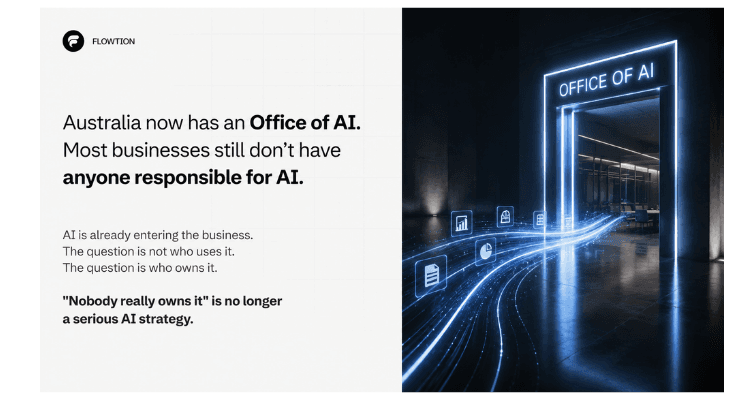
On 15 July 2026, the Australian Government announced a new Office of AI and plans for Australian Standards for AI.
For most Australian businesses, this does not mean a new compliance checklist lands on the desk tomorrow. But it does make one question harder to avoid.
Who is actually responsible for AI in your business?
Not who uses ChatGPT. Not who bought Microsoft Copilot. Not who reads about AI on LinkedIn. Who knows where AI is being used, what information is going into it, what work now depends on it, and what happens when something goes wrong?
In many businesses, the honest answer is nobody.
And that is becoming a problem.
AI is already entering the business
Marketing uses one tool. Finance tests another. Someone builds an automation in a spreadsheet. The CRM releases a new AI feature. An employee creates a workflow nobody else fully understands. The MSP says it is looking after AI.
Nothing looks dramatic on its own. But slowly, AI becomes part of how the business runs.
That is the moment when ownership starts to matter.
Most businesses do not need an AI department. They probably do not need a Chief AI Officer or another committee either. But somebody needs responsibility.
One person should be able to explain where AI is already being used, what information those systems can access, what has actually improved, what happens when something goes wrong, and who owns the workflow after launch.
Those are simple questions. Many businesses would struggle to answer them clearly.
Start with where AI is already being used. Include standalone tools, automations, and AI features appearing inside software the business already pays for.
Then ask what information those systems can see. Customer records? Financial information? Emails? Documents? Internal knowledge?
Then comes the harder question: what has actually improved?
Hours saved. Faster replies. Less rework. Fewer handoffs. More capacity.
If nobody can point to a before and after, the business may have more AI without having a better business.
And when something goes wrong, what happens next? Does the work stop? Does a person review it? Does anyone even know?
Someone also needs to own the workflow after launch. Errors need to be reviewed. Exceptions need to be handled. Processes change. Systems change. The business changes.
Without clear ownership, AI eventually becomes another piece of software everyone assumes somebody else is managing.
The hardest part is not buying the technology
AI is becoming easier to access. That does not make it easier to manage well.
A tool can save time and still create risk. A clever workflow can still solve the wrong problem. A team can use more AI and have no idea whether the business is actually better.
The difficult questions are often much simpler.
Should this workflow be automated at all? Where should a person stay involved? What happens when confidence is low? How will the business know whether the new process is better than the old one?
Those are not really technology questions.
They are management questions.
Start with one workflow
Do not begin with a giant AI strategy.
Start with one important piece of work and write down what it costs today.
Look at the hours involved. The delays. The errors. The rework. The waiting.
Then decide what better would look like.
Faster replies? Fewer handoffs? Less time rebuilding reports? Less dependence on one person?
Now there is a baseline. Now there is something to measure. Now someone can be responsible for knowing whether the change actually worked.
Australia creating an Office of AI does not mean every business needs more bureaucracy.
But it does say something about where we are.
AI is no longer sitting quietly in a browser tab. It is moving into the systems, decisions, and workflows businesses rely on every day.
And when something becomes part of how the business runs, somebody has to own it.
At Flowtion, this is where we believe good AI work starts. Not with another tool, but with understanding where AI is already showing up, what it is changing, and who is responsible for the result.
You do not need an Office of AI.
But "nobody really owns it" is no longer a serious AI strategy.
Sources
Australian Government, “AI in Australia's interests”, 15 July 2026. This is the primary source for the announcement of the new Office of AI and plans for Australian Standards for AI.
Australian Government, National AI Plan and related AI policy material, for broader context on Australia's approach to AI adoption, governance and responsible use.
Got a workflow that should run itself?
Tell us where the friction is. We will show you what is worth automating — and what is not.